
Joint letter: call for UK government to maintain ambition on the SAF mandate
SAF Mandate
Open letter | September 2026
Summary
Rebuilding the UK’s industrial capacity through green technology gives the UK a vital chance to deliver regional growth whilst also protecting our environment for years to come. It is with these priorities in mind that SASHA adds its voice to members of the SAF industry, NGOs and other interested parties, asking that the ambition of the Sustainable Aviation Fuel mandate (and particularly the e-SAF sub-target) be maintained.
The aviation industry claims that they cannot afford to keep up with the mandate, pointing to increased prices of jet fuel due to the Iran Crisis. We argue that they cannot afford not to invest in the future of the industry, and that changing course at this vital moment undermines the regulatory certainty that long-term investors require to deploy capital into British infrastructure and technology.
Read the full letter below.
Full text
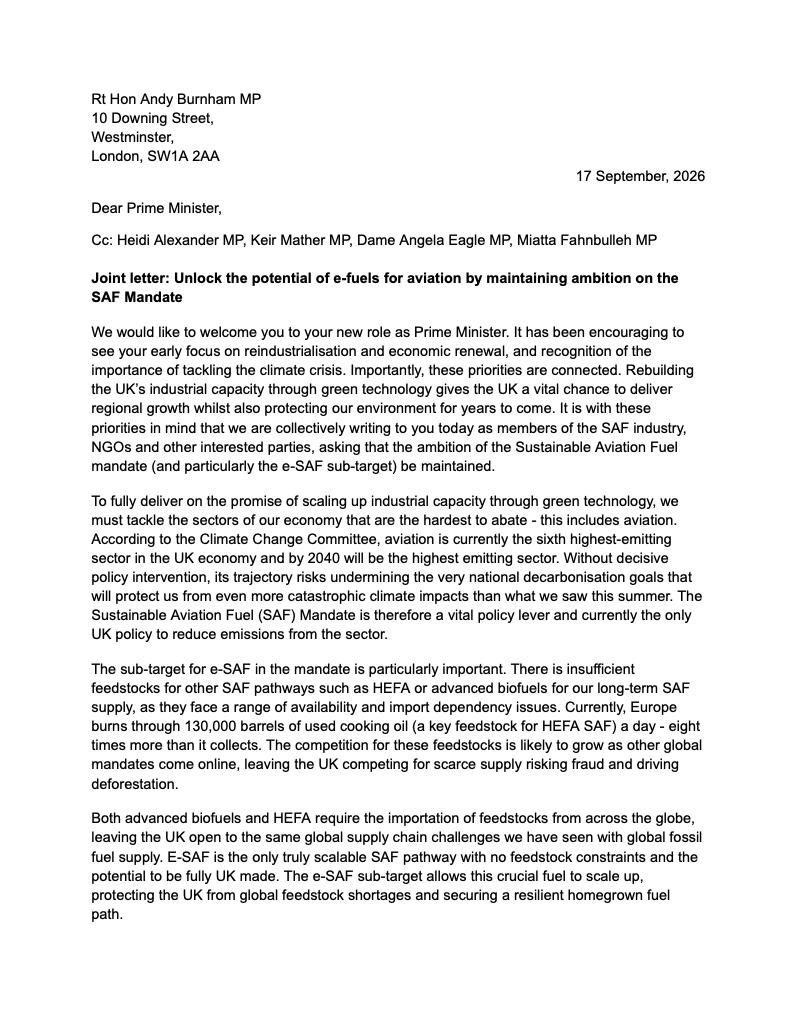
Dear Prime Minister,
Cc: Heidi Alexander MP, Keir Mather MP, Dame Angela Eagle MP, Miatta Fahnbulleh MP
Joint letter: Unlock the potential of e-fuels for aviation by maintaining ambition on the SAF Mandate
We would like to welcome you to your new role as Prime Minister. It has been encouraging to see your early focus on reindustrialisation and economic renewal, and recognition of the importance of tackling the climate crisis. Importantly, these priorities are connected. Rebuilding the UK’s industrial capacity through green technology gives the UK a vital chance to deliver regional growth whilst also protecting our environment for years to come. It is with these priorities in mind that we are collectively writing to you today as members of the SAF industry, NGOs and other interested parties, asking that the ambition of the Sustainable Aviation Fuel mandate (and particularly the e-SAF sub-target) be maintained.
To fully deliver on the promise of scaling up industrial capacity through green technology, we must tackle the sectors of our economy that are the hardest to abate - this includes aviation. According to the Climate Change Committee, aviation is currently the sixth highest-emitting sector in the UK economy and by 2040 will be the highest emitting sector. Without decisive policy intervention, its trajectory risks undermining the very national decarbonisation goals that will protect us from even more catastrophic climate impacts than what we saw this summer. The Sustainable Aviation Fuel (SAF) Mandate is therefore a vital policy lever and currently the only UK policy to reduce emissions from the sector.
The sub-target for e-SAF in the mandate is particularly important. There is insufficient feedstocks for other SAF pathways such as HEFA or advanced biofuels for our long-term SAF supply, as they face a range of availability and import dependency issues. Currently, Europe burns through 130,000 barrels of used cooking oil (a key feedstock for HEFA SAF) a day - eight times more than it collects. The competition for these feedstocks is likely to grow as other global mandates come online, leaving the UK competing for scarce supply risking fraud and driving deforestation.
Both advanced biofuels and HEFA require the importation of feedstocks from across the globe, leaving the UK open to the same global supply chain challenges we have seen with global fossil fuel supply. E-SAF is the only truly scalable SAF pathway with no feedstock constraints and the potential to be fully UK made. The e-SAF sub-target allows this crucial fuel to scale up, protecting the UK from global feedstock shortages and securing a resilient homegrown fuel path.
Rectify the regulatory paradox in Delegated Act 2023/1185 by applying the Commission’s already-established position from the Low-Carbon Fuels (LCF) delegated acts. The Commission recently and definitively ruled in Delegated Regulation (EU) 2025/2359 that "RFNBOs used as intermediate products for the production of conventional fuels and biofuels are not considered" when calculating final LCF output shares. We call on the Commission to correct the lack of coherence in DA 2023/1185 by integrating this exact exclusion, ensuring that the same industrial processes are not subject to contradictory accounting rules.
Increasing e-SAF production through the mandate doesn’t only have benefits for our climate. A domestic e-SAF industry would drive significant economic growth to regions by creating over 75,000 high-skilled green jobs by 2050. We have already seen e-SAF producers such as ETFuels confirm their flagship e-SAF site in the Humber industrial cluster, noting it as “a commitment to creating a new advanced fuels industry that will deliver jobs, growth and energy security for Britain for decades to come”. The Humber is also home to Velocys’ Altalto project, which plans to produce around 22,000 to 23,000 tonnes per annum of SAF from UK residual municipal waste. Project Starling in Workington, run by Carbon Neutral Fuels, is moving into its advanced engineering and pre-planning stage, and is expected to produce 31,000 tonnes per annum of eSAF by 2031.
Committing to long term domestic e-fuel production can unlock a raft of skilled jobs across the UK’s industrial heartlands. Crucially, it also strengthens our national energy security, shielding consumers from the volatile international oil markets by relying on local power rather than imported fossil fuels. Ensuring the security of fuel supply is becoming increasingly important in a fractured geo-political world.
The Government recently launched a call for evidence that opened up the question of weakening SAF mandate targets, including potentially the e-SAF sub-target. Ceding to pressure on this crucial piece of legislation would be a significant policy error. The aviation industry claims that they cannot afford to keep up with the mandate, pointing to increased prices of jet fuel due to the Iran Crisis. We argue that they cannot afford not to invest in the future of the industry, and that changing course at this vital moment undermines the regulatory certainty that long-term investors require to deploy capital into British infrastructure and technology.
We urge you to stand firm and maintain a strong SAF Mandate and e-SAF sub target, securing the UK's position as a leader in green aviation technology.