
Industry Insights: Adria Jover from IEMA
In this series of blogposts, we sit down with SASHA members to explore what drives their work and where policy support is most urgently needed.
In this edition, we speak to Adria Jover, President and Founder of the International Electric Maritime Association (IEMA), a trade body representing companies in the electrical maritime supply chain.
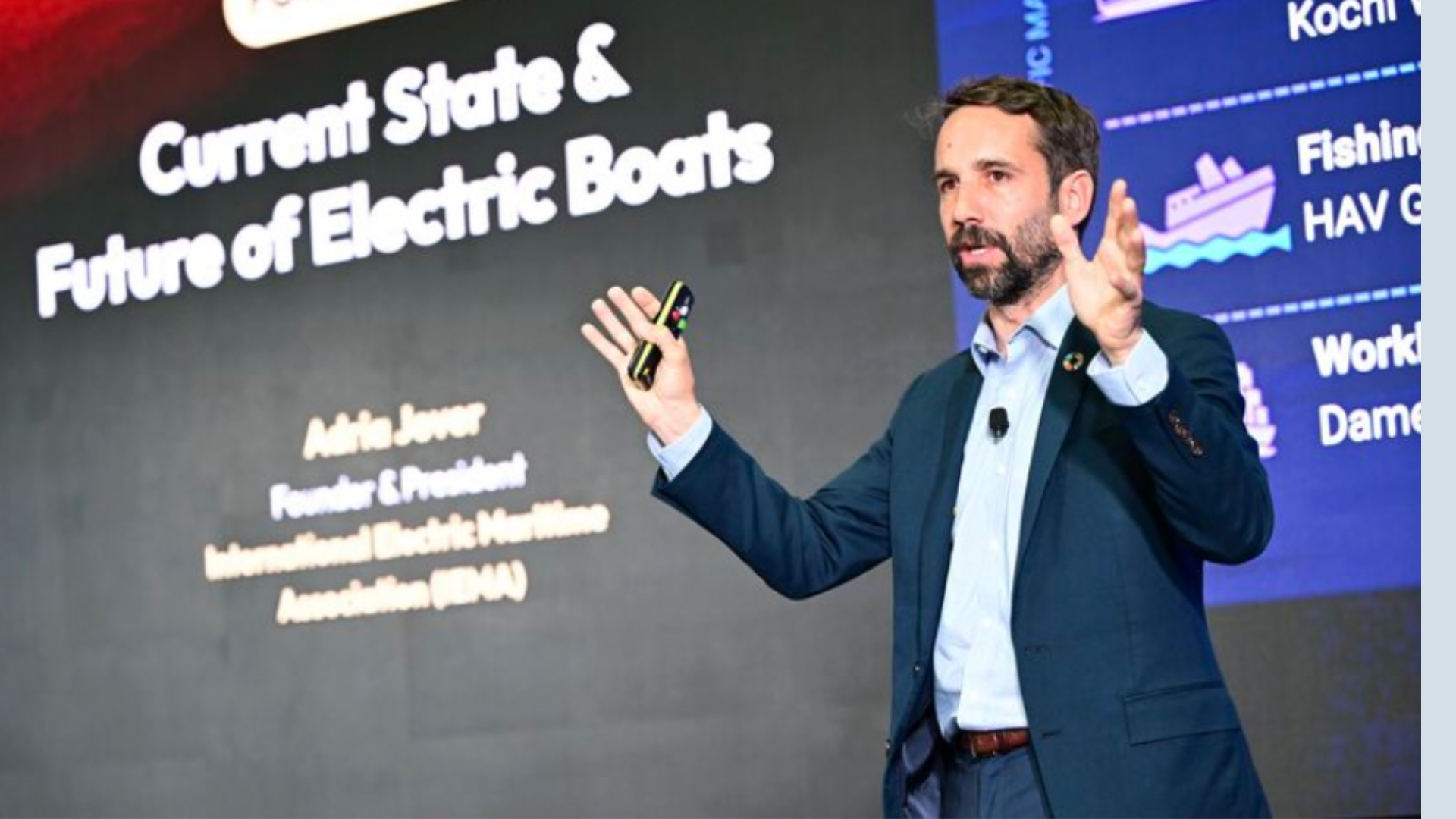
© IEMA
While the discussion about green shipping tends to focus specifically on the transition from dirty to sustainable fuels, another branch of solutions has long been coming into focus: direct electrification. As of 2023 the companies driving maritime electrification – of ships and shore facilities alike – have had a voice in the form of the trade body International Electric Maritime Association (IEMA), a SASHA knowledge partner.
“The truth is it was a beautiful accident,” Adria Jover explains how IEMA, of which he is President and Founder, came into being. Working in venture capital in the blue economy, Adria was rubbing shoulders with electric shipping developers and realised they weren’t organised. “They didn’t have any sort of collective representation,” he says, “and when I suggested such a project, they offered me to lead it.”
The way in which IEMA came into being set the tone for how it would go on to operate. “The way we started was unorthodox. Normally you have the combination of an agenda, one or two leading companies in one sector, and the support of a country or a region,” Adria explains. “We didn’t have founding corporations, nor a country supporting us at the beginning. That gives us a great deal of autonomy, independence, and, most importantly, our own voice”. Collaboration and participation are at the heart of IEMA’s ethos, and indeed part of the reason it joined forces with the SASHA Coalition. “If you want to go fast, you go alone, right?” Adria says, “If you want to go far, go together.”
Despite the increasing prevalence of electrified shipping technologies, they are yet to reach commercial-scale deployment. “The barrier used to be technological readiness,” Adria explains, “but that’s no longer the case: the innovation our companies are coming up with is truly amazing. The mindset of these engineers, mathematicians, physicists is phenomenal.”
Over the last three years the main hurdle has switched to a matter of financial return. While government grants in research and development have helped electrical technologies improve in efficiency, private capital is needed to translate them into everyday features of the maritime ecosystem.
“We know the chicken here comes first: it’s infrastructure.”
Beyond the propulsion systems themselves, investment is particularly needed in infrastructure. The lag in this area has created a chicken-egg scenario as is often the case with novel technologies as they emerge to compete with well-established legacy systems.
Until the infrastructure to accommodate new sustainable energy systems is in place, the risk burden appears steep for shipping stakeholders. “The question is whether the infrastructure is available for these boat operators, fleet owners, offshore vessels to commit to huge investments in new systems without knowing how much it’s going to cost them,” Adria says. “We need national programs that help ports have a clear understanding of how infrastructure, operations and charging facilities need to be deployed all under an interoperability national program. Without that, you’re asking boat owners to take on the weight of an outdated grid and infrastructure system.”
For Adria, it is clear what needs to move next. “It’s funny because you have electricity in almost every kilometre of shore where most maritime activity happens . It's just that you need to rethink the grid and build the last mile. So, in this chicken-egg we know the chicken here comes first, it’s infrastructure.”
But infrastructure doesn’t get built in a day. To accelerate the transition to the necessary pace, we will need temporary solutions that are modular and mobile, with a focus on interoperability.
De-risking investment in sustainable maritime solutions
The scale of the overhaul the maritime energy system is facing leaves a lot of question marks that stall progress notes Adria. “Who pays for what? What part of the infrastructure is supported by whom?” Today the biggest financial burden is borne by port authorities. While they can largely afford the costs, they are not the only stakeholders. “Shouldn’t the shipping companies, the cruise companies, the electric utility companies, be in charge of copayment for these upgrades too?”
A consequence of the blank-slate nature of shipping’s transition is that the business model for the electric utility companies is still undefined and many times opaque. Until the business model crystallises, expected returns are hard to predict and investment hard to attract.
How policy can stimulate investment
This is where ambitious and pragmatic regulation is key for kickstarting nascent markets. Adria points to the International Maritime Organization, that has been negotiating the net-zero framework (NZF) to decarbonise the international shipping sector. The measure is designed to both put a price on ships’ greenhouse gas emissions, and to collect and distribute the revenues generated to both ensure the transition is just and equitable, and to accelerate it with investment into zero and near-zero emission fuels and technology. Dedicating support to specific technologies is crucial for sending signals to private investors that there will be market demand for them in the future.
“Our theory is that it will stimulate the financial sector to deploy long term vehicles for investment,” Adria says. “We will see costs fall across all areas of the value chain, boats, infrastructure, charging. Once you start lowering the cost is when mass adoption occurs.” He points to other examples where this pattern has played out, including in the automotive sector. “But the cost of goods can only come down if there is a major policy framework that supports developers and provides investment security.”
“We just need to make sure that financial markets support the growth and commercialisation of these systems with market-standard returns.”
Learn more about IEMA here. The views expressed here do not necessarily reflect those of the wider SASHA Coalition.
The SASHA Coalition has proposed policies for accelerating the roll-out of port infrastructure in our briefings on the EU Ports and Industrial Maritime Strategies and the Alternative Fuels Infrastructure Regulation (AFIR).