5 Takeaways from the EU ETS proposal that the UK should learn from
What does the future of the UK’s Emissions Trading Scheme look like? Following the European Commission’s new proposal for a revised EU ETS this summer, it might offer a glimpse of what’s to come.
This autumn, the UK and EU are expected to come together to finalise the linkage of their respective emissions trading systems (ETS). However, as the EU ETS proposal brings a change in direction for the EU's treatment of aviation and maritime these discussions are likely to take on a new dimension, with opportunities for the UK to follow suit.
This shift in approach for both aviation and maritime also comes alongside wider policy and regulatory changes in the UK – with an updated Jet Zero Strategy expected next year and a suite of maritime decarbonisation policies set to be implemented off the back of last year’s Maritime Decarbonisation Strategy.
With this in mind, here are 5 key takeaways from the EU's ETS proposal that the UK should pay particular attention to.
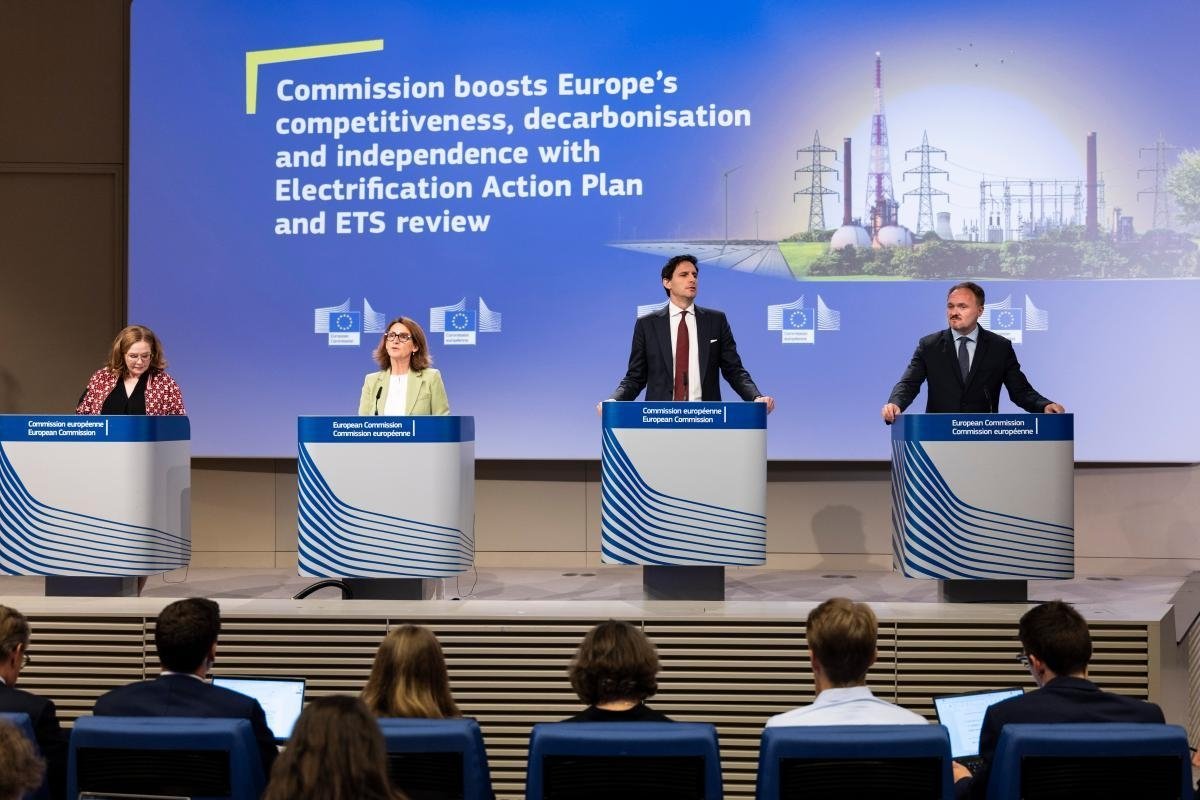
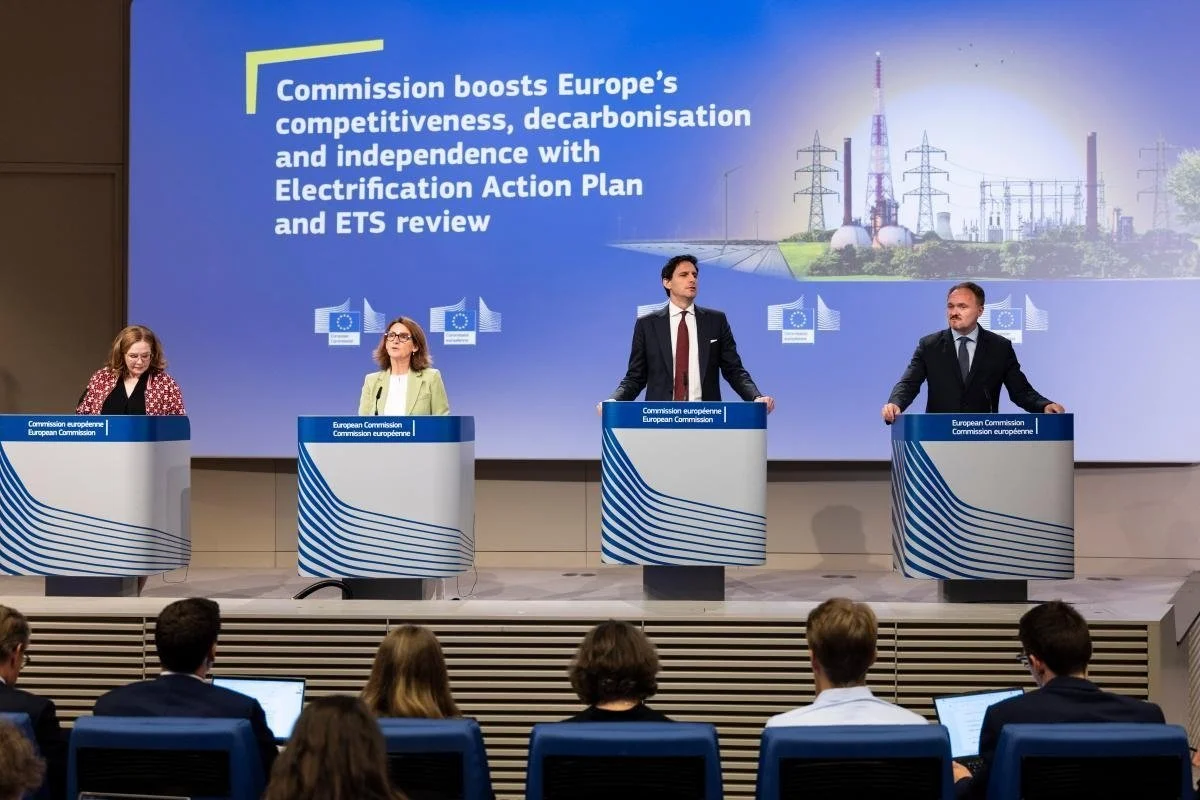
©European Union , 2026. Teresa Ribera, Executive Vice-President of the European Commission for a Clean, Just and Competitive Transition, Wopke Hoekstra, European Commissioner for Climate, Net Zero and Clean Growth, and Dan Jørgensen, European Commissioner for Energy and Housing, giving a press conference on the ETS review and the Energy package
1. You can't rely on CORSIA to manage international aviation emissions
The Commission's own analysis of CORSIA confirms that it is not delivering. Less than 70% of international aviation emissions are covered by participating member states and the scheme has not been strengthened as deemed necessary by the Commission.
As a result, the proposal has put forward a scope extension to cover all flights departing to destinations within a 5,000km radius of Frankfurt. While it is welcome to see some international emissions brought into scope, it falls short of applying to all departing flights. This inevitably leaves large markets, and a significant proportion of emissions, outside of the system.
The UK has long demonstrated its commitment to CORSIA. But the scheme is structurally unable to deliver the emission reductions necessary. It merely offsets emissions above a high baseline level, lacks stringent enforcement mechanisms and allows unsustainable crop- and fossil-based fuels to lower offsetting requirements.
If the UK wants to send a signal of intent that international aviation emissions must be strongly regulated – in pursuit of both emissions reduction and building demand for green solutions – it too must reduce its reliance on CORSIA.
The EU has made the first move by proposing the inclusion of some international emissions; when negotiating ETS linkage, both the UK and EU should now push this ambition further to all departing flights.
2. More support for zero carbon emission technologies is needed
Unlike the UK, the EU has a well-established approach for allocating ETS allowances to airlines for moving away from fossil fuels. To date these have been limited to the fuels that will be used to decarbonise aviation. However, from 2027, zero carbon emission aircraft will also be able to receive allowances under the proposal.
The UK has an extensive policy framework for scaling production of, and demand for, alternative aviation fuels, but this has not yet been replicated for zero carbon emission technologies.
While support for R&D exists from the Aerospace Technology Institute (ATI), among other schemes, the UK could draw on the proposal's ambitions to support the commercialisation of these technologies. Whether that be a similar allowances-style scheme, agreed as part of a linked ETS, or targeted policy support, attention must shift to creating an enabling environment for the commercialisation of zero carbon emission flight in the UK.
3. HEFA is a dead end
The EU's ETS proposal also marks a departure in its support for waste oil and fat-derived fuels - or 'HEFA' fuels – by removing them from eligibility for support via allowances by 2030. This change aligns with assessments that suggest supply of truly waste feedstocks will not be able to keep up with demand for these fuels, meaning that policy needs to be put in place to scale production of non-HEFA aviation fuels.
The same principle is underlined in the SAF Mandate's HEFA cap. Yet in a recent call for evidence, the UK government sought views on what impact the removal of the HEFA cap would have.
At a time when those investing into non-HEFA projects need certainty, the UK government needs to reaffirm – not move away from – it’s commitment to the HEFA cap and PtL sub-mandate. Clear policy intentions will be necessary if it wants to see finance flow into UK alternative aviation fuel projects.
4. There is opportunity in incentivising decarbonisation of smaller vessels
The current design of both the UK and EU ETS leaves vessels under 5,000 gross tonnage exempt. In fact, only 15% of maritime emissions are currently covered by the UK ETS.
But the EU’s proposal to extend coverage to (general cargo, tanker and offshore) vessels between 400 and 5,000 gross tonnage recognises that smaller vessels need an incentive to decarbonise too. This is particularly crucial as they have potential to be at the forefront of the transition to zero carbon emission technologies.
Not only will this ETS scope expansion incentivise more of the fleet to decarbonise, but it will also bring in much-needed additional revenues for the exchequer. A proportion of this could be invested into the technologies of the future like maritime e-fuels and zero carbon emission vessels.
By including vessels below 5,000 gross tonnage, plus the proposed 50% of international voyages, emissions coverage could be four times higher than it currently is, with a commensurate increase in revenues from £138-173m to £570-710m annually. While the majority of this increase does come from international expansion, that is not to diminish the importance of maximising coverage across vessel types. The UK Government should welcome this scope extension when negotiating ETS linkage later this year.
5. Ferries are the missing piece of the puzzle
Despite increasing the scope to include smaller vessels in the EU ETS proposal, smaller ferries are left exempt until at least 2031, when a feasibility study is due. This omission marks a significant missed opportunity given their significant potential to transition to electric power.
This technology is already within reach: as of 2024, there were already 70 electric ferries operating in Norway and over 400 electric vessels in China. If the UK wants to keep up with the leaders in these technologies, and capture some of the opportunity of being early adopters, then policy needs to drive the transition. Pushing for the inclusion of smaller ferries in the ETS, alongside other policy incentives, will be necessary to drive this transition.
Read more about the European Commission's revision of the EU ETS in our latest edition of the SASHA Coalition newsletter.